The Big Read: Frontline healthcare workers pushed to limits by non-stop, never-ending COVID-19 fight
SINGAPORE: It has been about viii months since Dr Wong Choo Wai ended his volunteer stint taking care of COVID-xix patients at Singapore Expo, just the l-year-old sometimes wakes up in panic, thinking that he has overslept and is tardily for work.
The senior family doctor is nevertheless reeling from his experience of working well-nigh 24/vii from April to September last year - pulling 12-hour volunteering shifts at the community care facility, while likewise still running his two clinics and seeing his regular patients.
Getting only three hours of sleep each day, Dr Wong said that at that place were days where he almost dozed off at piece of work due to the mental and physical exhaustion.
He recalled one particular nighttime in early May last year when he and other volunteers saw patients coming into the facility up until around 4am the next morning. Usually, new cases would stop coming in past midnight.
"The next day, nosotros were all so zonked out because each one of us saw at least a few hundred patients for that 12-60 minutes shift," he said.
"I will say that I haven't had a good intermission for a long time, and as much equally I'grand trying to get on every twenty-four hours without thinking too much about the past, I think I'chiliad a scrap burned out. And I think most of usa (frontliners) are, simply what to practice?"
READ: Commentary: A return to Phase 2 could be a momentary setback to Singapore's economical recovery
READ: Commentary: Five pandemic lessons we have learnt that should tide us over whatsoever surge in cases
Like Dr Wong, many healthcare workers on the front line have been in overdrive for over a year fighting a pandemic which has infected over 160 million people and claimed more than than 3 1000000 lives globally.
Not only are they working longer hours to comprise the far-from-tamed outbreak, they also shoulder the mental stressors of beingness abroad from loved ones, getting infected or passing on the infection to those around them.
These fears became very real for a Tan Tock Seng Hospital (TTSH) nurse, who was among the healthcare workers at that place served with quarantine orders after a 46-yr-old nurse tested positive for the infection concluding calendar month.
READ: A timeline of the Tan Tock Seng Hospital COVID-19 cluster
READ: 2 new COVID-19 clusters in Singapore, including tuition middle where five students test positive
The immature nurse, who did not want to be identified every bit she was not authorised to speak to the media, recalled being in a state of disbelief when she got the call from the authorities informing her that she and her colleagues had to be quarantined.
"I was merely like, 'No, it tin't be truthful lah.' I recall I was still in shock," she said.
Even though she was about to complete her quarantine in a few days when spoken to, the TTSH nurse said she felt apprehensive about what to expect at the hospital after she was released.
"I don't know how it's going to be similar, how messy or calm the situation will be … it's non settled yet, it's all play-past-ear. What if everything changes overnight and they have to implement something new to cope with the situation?"
Indeed, a common refrain among the healthcare workers interviewed is that a big part of the psychological toll comes from not knowing what to look when dealing with an unpredictable disease.
The new wave of infections has also served as a cruel reminder that there is still no end in sight to the COVID-19 pandemic.
Ms Alice Ng, 59, who manages the 24-hour family clinic at Thomson Medical Middle, said: "I've been a nurse for almost 33 years. I've been through SARS (severe acute respiratory syndrome) and H1N1, and this is the toughest pandemic I've ever met."
(Are COVID-19 vaccines still effective against new variants? And could these increase the risk of reinfection? Experts explain why COVID-19 could become a "chronic problem" on CNA's Middle of the Matter podcast.)
SERVING THE PUBLIC, SHUNNED BY THE PUBLIC
After months of few community cases, the rising number of local infections in recent weeks - which has Singapore "on the knife-edge", every bit Education Minister Lawrence Wong put information technology - has as well seen healthcare workers in several public hospitals coming downwards with the virus. This, in plow, has once once more led to incidents of them beingness discriminated against past members of the public.
Some healthcare workers have shared on social media their experiences of existence shunned in public, with some having difficulties booking a taxi or private-hire ride, and others receiving wary looks or unkind comments from strangers.
Associate Professor Kenneth Mak, the Ministry of Health'southward (MOH) director of medical services, said during a conference held by the Authorities'south COVID-xix job force that some TTSH healthcare workers had been kicked out of their accommodation afterward the landlords learnt that they work at the infirmary.
READ: 'Several important lessons' from Tan Tock Seng Infirmary COVID-19 cluster, says Gan Kim Yong
READ: Regime studying possibility of airflow and ventilation issues at Tan Tock Seng Infirmary ward
The healthcare workers spoken to also had experienced or heard of similar incidents of discrimination against their colleagues in recent weeks.
One medico, who works at a public infirmary, said she has not been able to have food delivered lately, every bit delivery riders have been rejecting orders coming from the hospitals. She declined to be named as she was not authorised to speak to the media.
Staff nurse Afidah Aziz, 29, who works at the isolation ward at Ng Teng Fong General Hospital, said she has gotten cold looks from taxi drivers subsequently they found out that she works as a nurse at the hospital.
"I don't wear my uniform when I get to work … just (the drivers) will ask considering they already know that I'thousand going to the hospital. They will ask, 'What are you working as?' Then whenever I say 'nurse', I will go them staring at me," she said.
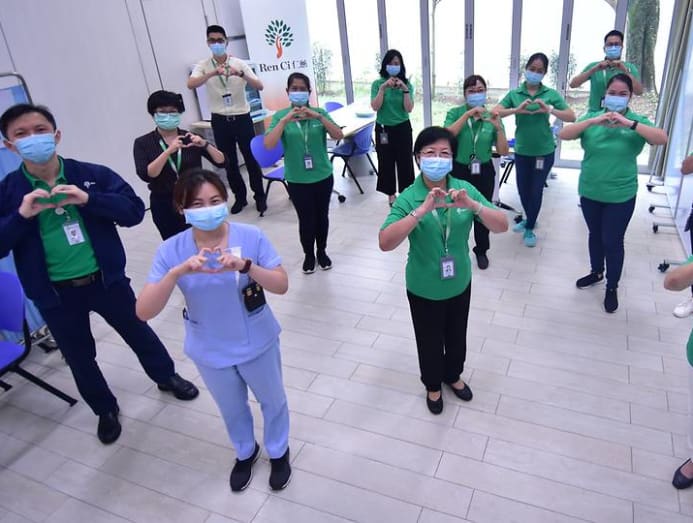
Ms Jenny Sim Teck Meh, 70, chief nurse at Ren Ci Infirmary - which is near TTSH - said a few of her nurses have reported that commuters steer clear of them on MRT trains.
"Information technology'southward very disappointing to know that some people can behave like that, I don't think that'south humane," she said.
Posting a screenshot showing drivers on ride-hailing app Catch cancelling rides to TTSH, Speaker of Parliament Tan Chuan-Jin said on Facebook earlier this week: "All of us tin can support our folks at the frontlines. It'southward the to the lowest degree we can do."
Prime Minister Lee Hsien Loong also voiced his business organisation, maxim that information technology is "sad to run into" the incidents of discrimination against TTSH staff members.
"We cannot let setbacks divide united states or wear us down, because if we lose our unity, the virus has won," he wrote on Facebook on May 7.
Responding to a question by Jurong Grouping Representation Constituency Member of Parliament Tan Wu Meng on Tuesday, Health Minister Gan Kim Yong said in Parliament that the authorities have been working together with hospitals to provide support for the affected workers.
The Government is also working with hotel operators to provide alternative accommodation for healthcare workers who have been asked to move out by their landlords.
Mr Gan added: "Nosotros desire to urge Singaporeans to also bear witness their back up to these healthcare workers because they are putting themselves in harm's style to protect us, then let us work together to protect them."
READ: Commentary: Booster shot for COVID-19: Not everyone needs information technology
READ: Pre-event testing to be subsidised for live performances amidst tightened COVID-19 measures
In response to these incidents, ride-hailing house Gojek said it is working with TTSH to provide a S$10 voucher to all hospital employees.
Lien Choong Luen, the firm's general manager, said Gojek is also stepping upwardly education outreach efforts to its drivers to remind them that trips may include infirmary pick-ups, and therefore, they should implement precautions to ensure a safety environment.
Mr Tan had updated his Facebook mail service with a response from Grab, which said that it had met with TTSH recently to see how it tin can support the hospital during this period.
Grab added that it has started recruiting more volunteers for its GrabCare service, which provides circular-the-clock rides home for healthcare workers at a lower commission rate.
READ: Commentary: Why many nether 45 are hoping vaccination slots open in June
IN FOCUS: Tackling COVID-19 with targeted measures - the new normal for Singapore?
SACRIFICES Counterbalance ON Family
For healthcare workers who play dual roles of frontliner in the hospital and caregiver at habitation, the work does non end even after they accept changed out of their scrubs.
Dr Brenda Mae Alferez Salada recalled how, during the circuit billow from April to June last twelvemonth, she would return dwelling later a long day at work to help her son with his home-based learning.
But unlike other parents who played the office of teacher during that menstruum, the forty-yr-erstwhile resident physician at the National University Hospital'due south (NUH) division of infectious diseases could just jitney her son through FaceTime and video conferencing app Zoom, even though they were living nether the same roof.
That was considering Dr Salada and her husband, who works at TTSH, had chosen to isolate themselves from their son and helper in gild to minimise the risk of spreading the infection to them.
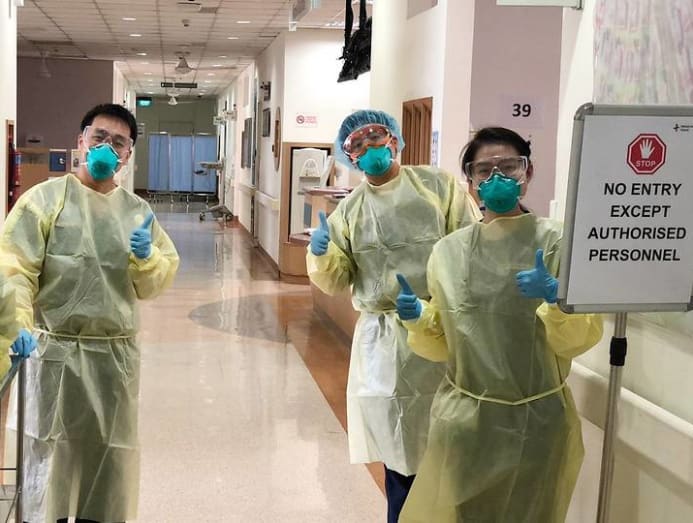
At the time, a lot was still unknown about the nature of the disease. They did not want to accept whatsoever risks since she and her hubby worked in the pandemic wards and the emergency department respectively.
Though they eventually reunited subsequently a month when they were assured of the rubber of infirmary protocols and personal protective equipment (PPE), the family unit has recently been separated again because of the TTSH cluster.
Since Dr Salada no longer works in the pandemic wards, the family thought it is safest for her husband to isolate himself at a hotel.
"Initially my son was quite okay … but one time they appear that (my husband has to stay abroad) until the end of the calendar month, so it sank in, and he didn't desire to go to school because he didn't know when daddy would come back," she said.
READ: Commentary: Flaring tempers and public incidents – are we losing it considering of COVID-xix?
READ: Additional COVID-19 antigen rapid testing to be rolled out for people with symptoms
For Dr Crystal Soh, the most challenging menses was during last twelvemonth's circuit breaker when she and her husband, who is an emergency specialist at TTSH, had to juggle long and draining shifts at work with coming dwelling to care for their children, who were then 1 and three years onetime.
Every bit the couple did not want to put their elderly parents at chance of infection, they decided to stagger their work shifts then that either one of them could be with the children while the other was at piece of work.
"The most difficult role was it was very intense. At work we were seeing very sick patients, being in the total set up of PPE all twenty-four hours, and then we had to quickly bathe, rush domicile, then do the kiddie stuff - depict, read to them, exercise home-based learning with them," Dr Soh said.
"It was really a full day of work until they slept," added the 32-year-old associate consultant at NUH'southward department of emergency medicine.
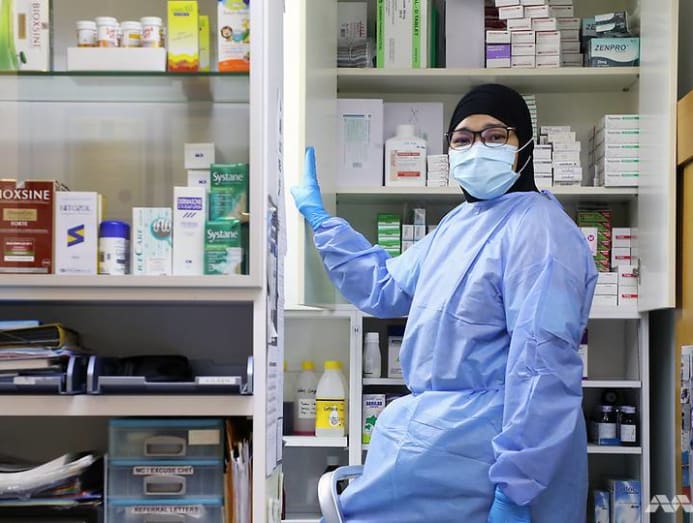
Ms Norashinta Mansoor, 39, a dispensary assistant and trained nurse with Healthmark Medical Clinic in Punggol, said the long hours hateful that sometimes she would have to rush to the infant care centre to selection up her 13-month-quondam baby.
She has gotten used to the fact that Mondays, Tuesdays and Fridays are busiest at the clinic, which is also a Public Health Preparedness Dispensary that conducts swab tests. On those days, she would alarm her 11-twelvemonth-old daughter that she would have to exist habitation alone for a while every bit Ms Norashinta finishes up at the clinic.
Concrete AND MENTAL Cost
After over a year of fighting an backbreaking, seemingly unending battle confronting an invisible enemy, many of the frontliners interviewed admitted that it is difficult to continue their chins up at times.
Many of them said the frequently changing protocols - that can sometimes happen in the middle of a shift - and the logistical adjustments that come with them, tin can be overwhelming.
For those who work in high-risk wards, the process of gowning up and spending a whole twenty-four hours in PPE is physically draining, especially for someone like Dr Soh, who at present has to do this while pregnant with her third child.
Then, there is the stress of dealing with patients and their family unit members, who at times practise not understand why these strict protocols have been put in identify.
Dr Praseetha Nair, 33, an associate consultant at Khoo Teck Puat Infirmary's (KTPH) acute and emergency ward, recalled an incident where a critically ill elderly patient with a lung infection had arrived at the infirmary with 10 other family unit members, and all of them wanted to come in and be with the patient.
At the time, the department was not allowing visitors, to curb the COVID-xix spread.
"Information technology was particularly difficult explaining to this family unit (why they couldn't visit him) … and unfortunately, information technology got to a stage where they were quite frustrated, and they took out their frustrations on my squad and me," said Dr Nair.
READ: Changi Airport to segregate flying arrivals from high-risk countries, regions
READ: Start 20 Changi Aerodrome COVID-nineteen cases from zone that receives arrivals from college-hazard countries, says Ong Ye Kung
Dr Nair said she and her colleagues take encountered a handful of like cases over the past year, where families would ask the hospital to make an exception to allow them see their relatives.
"But the responsibility falls on us to make sure that all our patients, and their relatives, are taken care of. Because there only needs to exist one slip somewhere, and it can have repercussions down the road, similar a domino effect, and we don't want that to happen."
She added that such incidents tin can take a toll on her considering it leaves her constantly thinking what could have been done better to help patients and their families in the situation.
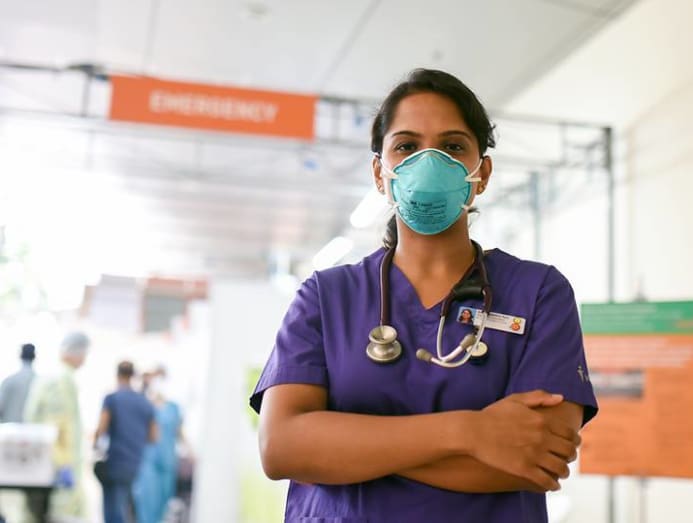
Dr Jansen Koh, principal and senior consultant at Changi General Hospital's (CGH) respiratory and critical care medicine, said at that place are times when he and his colleagues struggle to hold back their emotions while caring for patients who are critically ill with COVID-xix.
"They would not be able to have family members and friends at their bedside. Understandably, this makes the journey to recovery even harder for them. As healthcare workers, we effort our best to be with them though we are all fully gowned up and take to minimise unnecessary contact," he said.
For the young TTSH nurse, the gravity of her state of affairs finally sank in halfway into her quarantine, and she found herself breaking down after a video call with her colleagues who were also in isolation.
"We weren't even talking virtually anything specifically nearly (the cluster) ... I don't know why only that was when it dawned on me that, okay, this is actually happening to me," she said.
"I think that was when the fear set in. I was thinking, 'Oh no, what if I have (COVID-19)? What do I do side by side? What if I have to be hospitalised?' I don't think I can deal with beingness in the hospital on my own," she added.
She had spent the days before trying to remain calm and staying strong for her family, but the isolation and psychological stress somewhen became likewise much to handle on her own.
"Considering I see that (my family) is so scared, I cannot be scared ... fifty-fifty though I'm the one facing it," said the nurse.
READ: Several Wang Learning Heart students to quarantine after sharing form with student from Learning Point COVID-19 cluster
READ: two students at The Learning Lab amongst latest COVID-19 cases at tuition centres
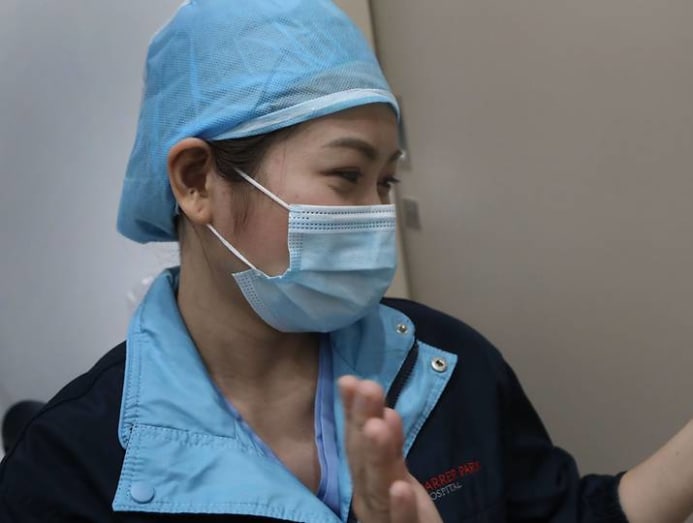
Another frontliner, Filipino staff nurse Princess Joyce Aguas, went through a tumultuous time when her family members, who live in Mexico, Pampanga, in the Philippines, contracted COVID-19 last calendar month.
Her male parent was in critical condition later contracting the disease and her family was in crunch mode going around to different hospitals trying to secure him a bed.
"It was 6am and I was sleeping when my sister called me and told me, 'Papa wants to be rushed to the hospital correct now,'" the 33-twelvemonth-one-time nurse from Farrer Park Infirmary said.
"I got so worried that I cried … Over the phone I was telling them it'southward going to be okay and to non be scared, but deep in my heart I knew information technology was bad."
Ms Aguas, who has not seen her family since February last twelvemonth, said she felt helpless at not being able to be there with them.
She had considered flying back then, only the next flight to the Philippines was a month away. That, combined with the lengthy quarantine period there and in Singapore, made information technology pointless to return habitation.
So she could only assist her family over video calls - giving instructions to her siblings and checking up on her father's condition virtually. Her male parent has since stabilised.
Asked how she managed her emotions while keeping up with the daily barrage of piece of work, Ms Aguas said that although she sometimes could not stay focused, she tried to remain positive and left her personal issues behind when she tended to her patients.
"It motivated me more that whatsoever care I wanted to give my family unit, I simply gave it to the people who were in front of me. So that'south how I treated our patients here," she said.
WHAT KEEPS THEM GOING
Getting through the tireless, long days can be difficult, merely healthcare workers said they find strength in the camaraderie of their boyfriend frontliners.
While all of them expressed endless gratitude for the support from loved ones and friends, the healthcare workers said information technology is sometimes difficult for others to relate to the unique experiences of being on the frontline.
This is specially so when there are parts of the job that accept to be kept confidential.
Dr Nair said: "I think equally a result of this entire experience, I kind of bonded and got close to a few of my colleagues at work. It helped us that we were able to sound off each other and talk to each other."
READ: Pre-schoolhouse outdoor activities reduced to 2 children per group amid stricter COVID-19 measures
Similarly, the immature TTSH nurse said getting through quarantine has been fabricated easier knowing that all her other colleagues are going through the same experience and rollercoaster of emotions.
Her bosses also schedule twice daily Zoom calls to check in with anybody's mental health. She as well has video call sessions with her closer colleagues in the ward three times a twenty-four hour period to go along each other visitor.
"Unfortunately, I would say information technology'southward a lucky thing where most of u.s.a. are quarantined and then we do take people who are going through the aforementioned thing during this period," she said.
"Sometimes we will but video telephone call to keep each other company, but we would all be doing our ain affair."
Dr Soh said at the peak of the pandemic last year, her colleagues would offer to take over her shifts, or offering their days off if she needed more fourth dimension with family. They also reassured her that information technology was okay to be late for piece of work if her husband did not come back in time to take over with the kids.

Dr Wong, the family doc, said his friends would offer to run errands for him. Some even offered to help him fight gym leaders on the mobile game Pokemon Become on his behalf, he quipped.
"It's good to know that people are holding your dorsum when you need them to," he said.
READ: About five,000 inmates, staff to be tested for COVID-19 subsequently cook at Changi Prison house tests positive
In response to queries, the hospitals said they have introduced various initiatives to heave morale and take intendance of the mental well-being of their healthcare workers.
For instance, TTSH has introduced a helpline and chatbot for staff who need counselling and emotional support.
The hospital is besides working with MOH to provide staff who crave culling accommodation with a temporary place to stay. These are staff members who alive with elderly parents, young children or immunocompromised individuals.
A National University Health System (NUHS) spokesperson said information technology has offered free counselling sessions for staff members to provide them with emotional back up.
Resilience workgroups accept been formed to strengthen staff health and mental health. NUHS staff members have also been provided with meals and refreshments during this period.
Mr Stephen Chong, CGH'due south chief human being resources officer, said information technology has run virtual health and health programmes - such as yoga, piloxing, and qigong do classes - to help staff members go along fit and stay emotionally resilient.
"Meals were also provided to frontliners whose movements may be restricted for infection control purposes," he said.
READ: Shangri-La Dialogue organiser remains 'committed' to holding this year's event in person
Meanwhile, Sengkang Full general Hospital and KTPH have a dedicated peer back up squad which staff members tin can achieve out to when they need a listening ear.
Some healthcare workers take also pitched in with efforts to cheer up their peers and colleagues.
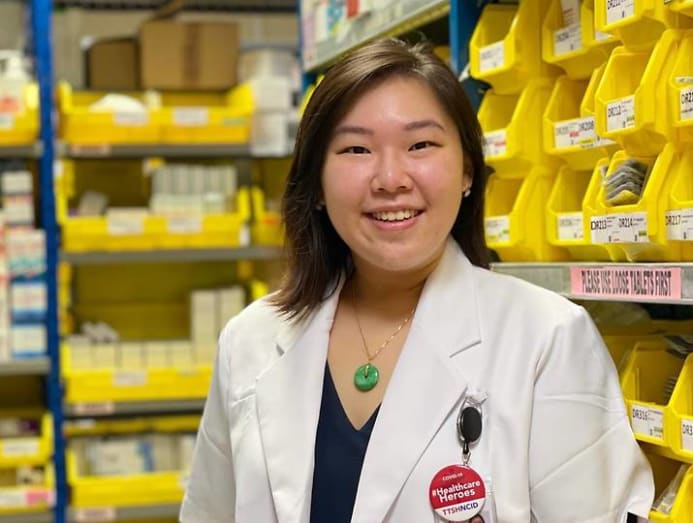
I of them is Ms Azrina Imran Tan, 26, an in-patient pharmacist at TTSH. She is part of the social commission in her department, where she looks after her colleagues' welfare.
When the TTSH cluster broke out and her colleagues had to be quarantined, she and the other committee members reached out to those in isolation to bank check in on their well-existence.
Over the Mother's Day weekend, they prepared care packages for the children whose mothers were in quarantine to explicate to them why the women could not gloat the day with them.
Ms Azrina recalled that one colleague cried after she received a carte du jour with letters from their other co-workers.
"She said that she'd been feeling quite down… then when she received the carte du jour, she cried because she felt that fifty-fifty though she was physically solitary, at that place were people looking out for her," she said. "That touched me quite a fleck."
Ms Sim, the Ren Ci chief nurse, said she would ofttimes buy breakfast and snacks for her nurses to give them an energy heave, especially since they cannot dine together during or outside of work.
Aside from their colleagues, the frontline healthcare workers said they besides felt encouraged by the beloved shown to them by members of the public and their own patients.
For instance, when the COVID-19 outbreak was at its worst last year, the hospitals received many care packages containing food, drinks and notes of encouragement.
Remembering that period, Dr Nair said: "I think those gestures were far from small because it'due south a reminder that yous're being looked out for and that at that place are people out in that location who capeesh what you're doing."
READ: No dining-in at eateries: Restaurants pivot again, food delivery services gear upwards
READ: Singapore'south stocks 'adequate' at supermarkets and 'supply lines intact': Chan Chun Sing
Dr Wong said his patients, who knew that he had cutting back his clinic hours to volunteer at the customs care facility, also gave him food, goodies and words of encouragement when they came to meet him at the clinic.
Some of them would likewise plan their schedules around his by coming for their appointments earlier so that he could get out on fourth dimension to arrive for his volunteering shift.
At the customs care facility, the migrant workers were likewise very appreciative, always expressing gratitude when they were existence examined.
"It makes us experience good … at to the lowest degree nosotros know that we are making a divergence," he said.
READ: Commentary: COVID-19 unlikely to become a thing of the past someday soon
READ: Commentary: Paying nurses more is long overdue but they demand clearer professional person ladders too
GEARING UP FOR WHAT'S Adjacent
Looking dorsum on his experience, Dr Wong said he found it "quite incredulous" how he managed to survive those vi months volunteering and running his 2 clinics in Bedok and Jurong.
Yet, he is now prepare to head back to the frontline again.
Merely last calendar week, he received a call from the National Centre for Infectious Diseases (NCID) to help out at its emergency department. Of course, he said yeah.
"I'm very blessed to be given this opportunity to help out, because I know that even amongst medical professionals, a lot of people want to exercise something and assistance, but they may not exist given an opportunity, or may not be suitable to exercise so," he said. "So fifty-fifty though it's demanding, I'yard also very fortunate that I was picked to help."
This sense of duty was echoed by other healthcare workers interviewed.
Though the piece of work can be tough, they are prepared to take on the challenges arising from a crisis, such every bit the COVID-19 pandemic, every bit this is what they have signed up for as medical professionals, the frontliners said.
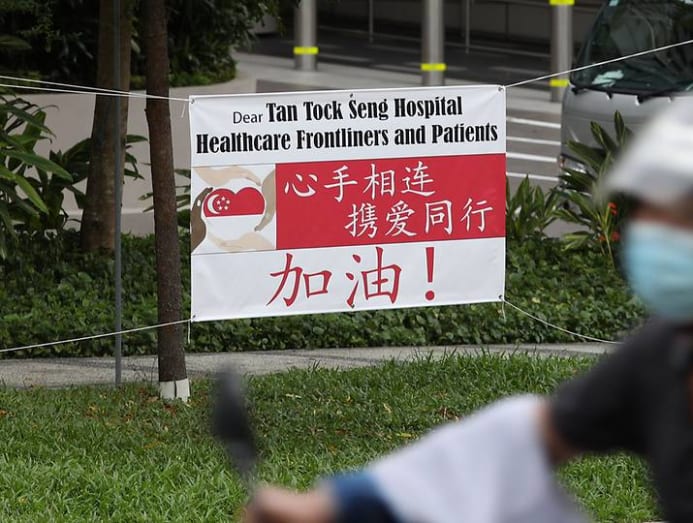
Notwithstanding, like anybody else, they, likewise, are looking forrard to the mean solar day when the pandemic volition be finally over.
When asked what is the first affair they want to exercise when everything is back to normal - albeit a new one - many of them cited much sought-after pre-pandemic luxuries, such as travelling, and being able to visit relatives living abroad.
Merely for some - such equally the frontliners currently in quarantine - what they look forward to can exist something as simple equally the thought of finally going out to enjoy your meal at a restaurant.
"Honestly, (I'm looking forward to) going out to places to eat. Or perhaps simply walking around shopping," said the young TTSH nurse.
BOOKMARK THIS: Our comprehensive coverage of the coronavirus outbreak and its developments
Download our app or subscribe to our Telegram channel for the latest updates on the coronavirus outbreak: https://cna.asia/telegram
For more news like this, visit todayonline.com
Source: https://cnalifestyle.channelnewsasia.com/singapore/big-read-frontline-healthcare-workers-pushed-limits-non-stop-never-ending-covid-19-fight-295471
0 Response to "The Big Read: Frontline healthcare workers pushed to limits by non-stop, never-ending COVID-19 fight"
Postar um comentário